


A tree may look healthy from a distance while developing structural problems that increase the risk of falling branches or complete failure. Dead limbs, trunk cracks, root damage, and fungal growth can indicate declining health, but these conditions do not always mean the tree needs to be removed.
Common warning signs include extensive decay, widespread branch death, significant trunk damage, compromised roots, and sudden leaning. The severity of these problems, along with the tree’s location and surrounding conditions, helps determine whether removal is appropriate.
A professional assessment can determine whether a damaged tree poses a safety risk or can be preserved. For property owners clearing overgrown land or preparing for improvements, professional brush and vegetation removal can help remove unwanted growth while preserving desirable trees where practical.
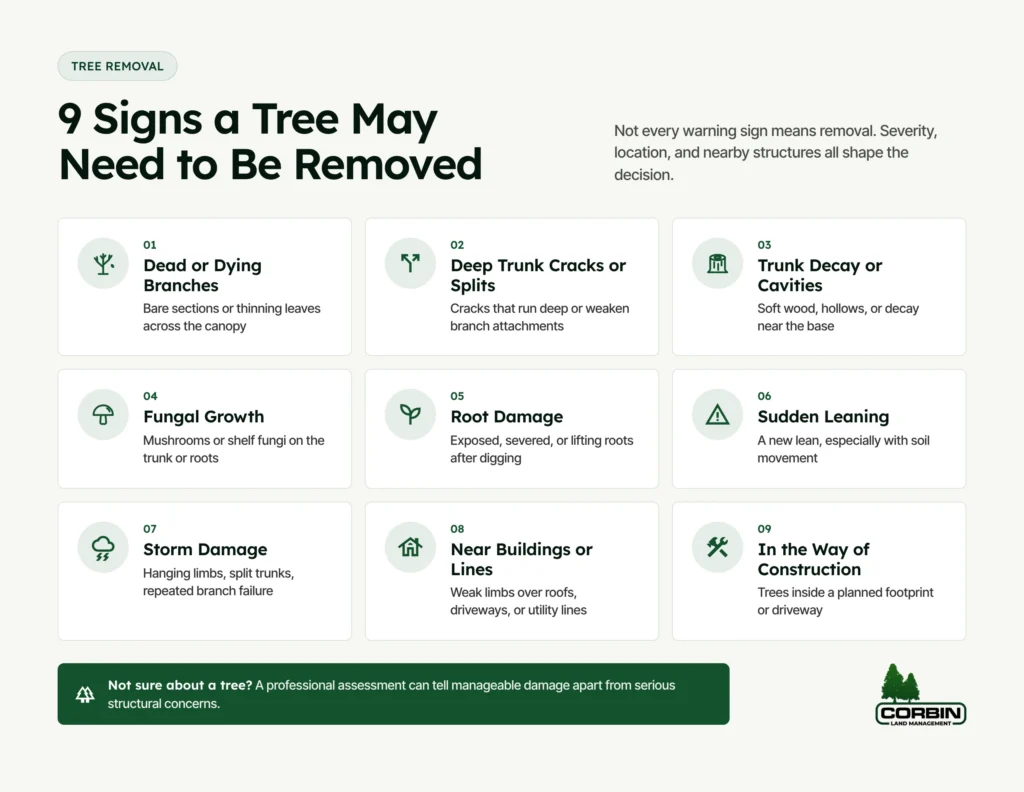
1. Extensive Dead or Dying Branches
One of the most noticeable signs of a dying tree is widespread branch dieback.
A healthy deciduous tree normally develops foliage during its growing season. Large sections without leaves, unusually small foliage, or repeated branch loss may indicate declining health.
Other symptoms include:
- Dead branches throughout the canopy.
- Sparse or uneven leaf growth.
- Premature leaf discoloration.
- Reduced growth over several seasons.
- Repeated limb failure.
These symptoms may result from disease, drought, insects, or root damage.
A single dead branch can often be removed through professional pruning. Widespread decline, particularly when accompanied by structural defects, requires closer evaluation.
2. Deep Trunk Cracks or Splits
The trunk supports the tree’s weight and connects the canopy to its root system. Deep cracks, major splits, and damaged branch attachments can weaken that support. Vertical cracks extending through substantial portions of the trunk may indicate structural problems, especially when combined with decay. Trees with multiple large stems can also develop weak attachment points.
The International Society of Arboriculture’s tree risk guidance identifies trunk cracks, split stems, cavities, and weak branch attachments as conditions that warrant assessment. Minor surface cracks are not automatically dangerous. Their significance depends on depth, location, and the condition of the surrounding wood.
3. Significant Trunk Decay or Cavities
Wood decay gradually reduces a tree’s structural strength.
Warning signs may include soft or crumbling wood, large cavities, extensive bark loss, and visible deterioration around the trunk base. However, a hollow tree is not necessarily dead. Living tissue near the outside of the trunk can continue transporting water and nutrients even when the center contains decay. The concern is whether enough sound wood remains to support the tree.
Decay near major branch attachments or the trunk base may be particularly significant. Trees with extensive deterioration near homes, driveways, or frequently used outdoor areas should receive professional evaluation.
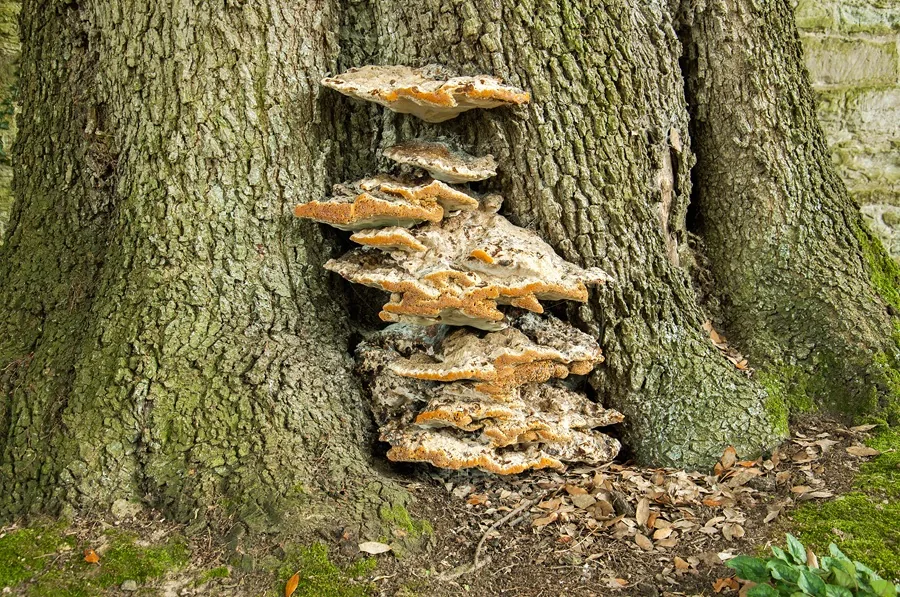
4. Fungal Growth Near the Trunk or Roots
Mushrooms and shelf-like fungal structures can indicate internal wood decay or root disease. Certain fungi break down structural wood, potentially weakening the tree.
The University of Maryland Extension identifies fungal pathogens associated with root rot and declining tree health.
Possible symptoms include:
- Fungal growth on the lower trunk.
- Mushrooms emerging near major roots.
- Declining foliage.
- Bark deterioration around the base.
- Reduced growth or branch dieback.
However, mushrooms growing nearby may simply be decomposing buried organic material. Fungal growth should be evaluated alongside other symptoms rather than treated as automatic evidence that a tree must be removed.
5. Root Damage and Ground Movement
A tree’s roots provide stability while absorbing water and nutrients. Excavation, construction, soil compaction, disease, and environmental stress can damage those roots.
Potential warning signs include exposed or severed major roots, lifting soil, cracks near the trunk, and declining foliage after nearby construction. The University of Maryland Extension’s guidance on damaged tree roots explains that construction-related injuries may take months or years to produce visible symptoms.
A tree can initially appear healthy after excavation but gradually decline as damaged roots lose their ability to support normal growth. Root movement accompanied by new leaning may indicate a more immediate structural concern.
6. Sudden or Increasing Leaning
A leaning tree is not automatically hazardous. Some trees develop a natural lean while growing toward sunlight or adapting to surrounding conditions. A longstanding lean may be stable.
A sudden change in position is more concerning, particularly when accompanied by exposed roots, soil movement, or trunk cracking. These conditions can indicate that the root system is losing stability. The direction of the lean also affects potential consequences if the tree comes down.
A tree leaning toward a home or other building can pose a greater risk than one leaning into an open field. If a tree suddenly starts leaning after a storm, keep people away from the area until a qualified professional can assess its stability.
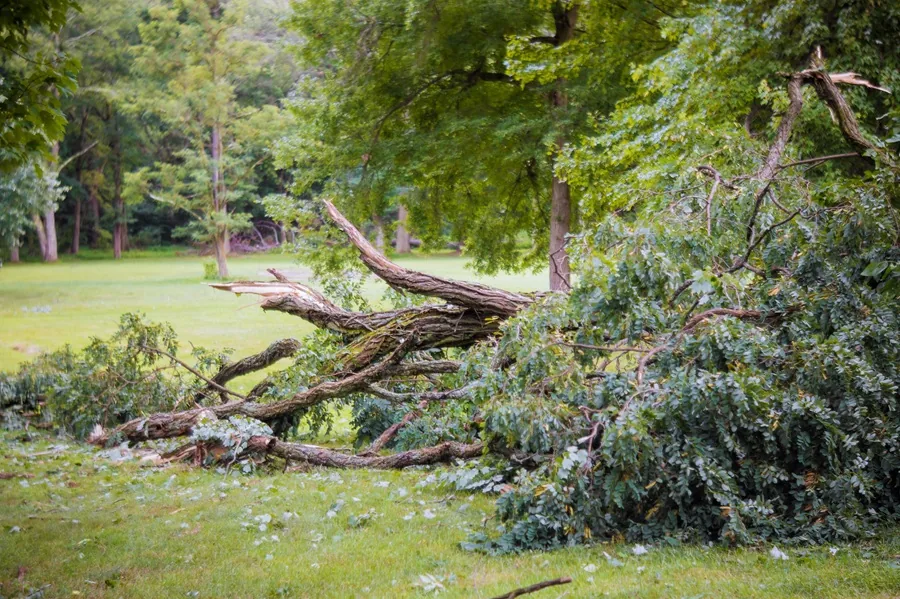
7. Repeated Branch Failure or Storm Damage
Severe weather can break branches, split trunks, and damage major structural connections. Some trees recover after damaged limbs are professionally removed, while others sustain injuries that compromise their remaining structure.
Dangerous tree warning signs following storms include hanging branches, partially detached limbs, split trunks, and exposed root systems. Repeated failure of large branches may indicate decay or weak attachment points.
The decision to remove a storm-damaged tree depends on its remaining structure, overall health, and proximity to people or property. A professional evaluation can determine whether selective pruning is reasonable.
8. Trees Near Buildings or Utility Lines
Tree location can influence removal decisions even when the tree is healthy.
Large branches may extend over roofs, garages, driveways, or fences. Roots may also interfere with planned excavation or underground improvements. Proximity alone does not justify removal. A healthy tree with sufficient clearance may be manageable through routine maintenance. However, branches showing structural weakness above frequently used areas, or roots affecting planned construction, may require a more detailed evaluation. The tree species, mature size, structural condition, and available space should also be considered.
Trees growing near energized utility lines require more caution. Utility providers or qualified line-clearance professionals should address vegetation that creates electrical hazards.
9. Trees Interfering With Construction
Tree removal may be necessary when existing vegetation interferes with planned construction, even if the trees are healthy. Trees located within a proposed building footprint, driveway, or utility installation area may need to be removed.
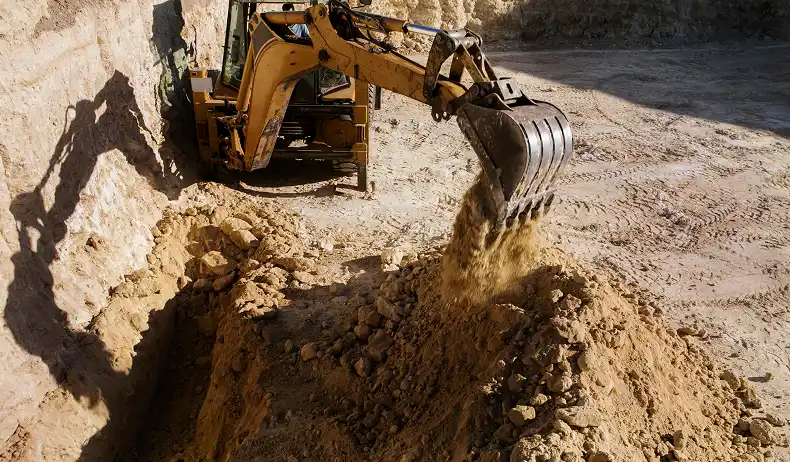
Evaluating trees before construction begins can help property owners identify which trees can be preserved and which may interfere with the planned work. This is particularly important when grading or excavation will occur near mature trees, where protecting major root systems may limit the available work area.
Larger land projects may also involve stump grinding, debris removal, and rough grading to prepare the property for development.
Can a Damaged Tree Be Saved Instead of Removed?
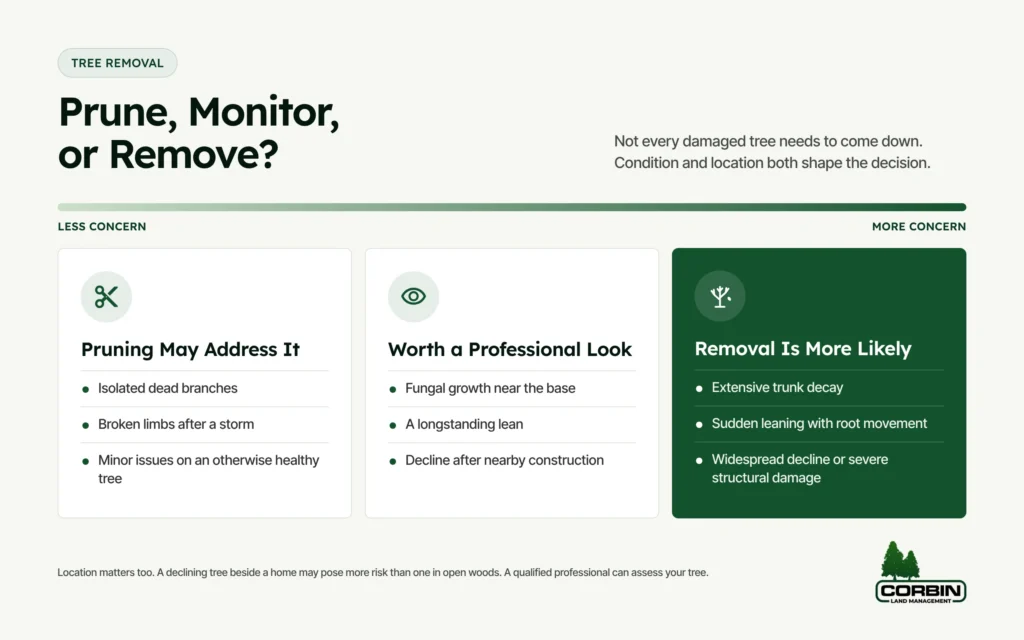
Not every tree showing signs of damage needs to be removed. Professional pruning may address isolated dead branches, broken limbs, or certain structural concerns when the remaining tree is healthy and stable. Some conditions may also be managed through treatment or continued monitoring.
Removal becomes more likely when a tree has extensive decay, severe root instability, widespread decline, or structural damage that cannot reasonably be corrected. Its location also matters. A declining tree in an open wooded area may pose less immediate risk than one beside a home, driveway, or frequently used outdoor space.
An ISA Certified Arborist can assess the tree’s health, structural condition, and surrounding environment to determine whether preservation is reasonable or removal is the safer option.
What Professional Tree Removal Involves
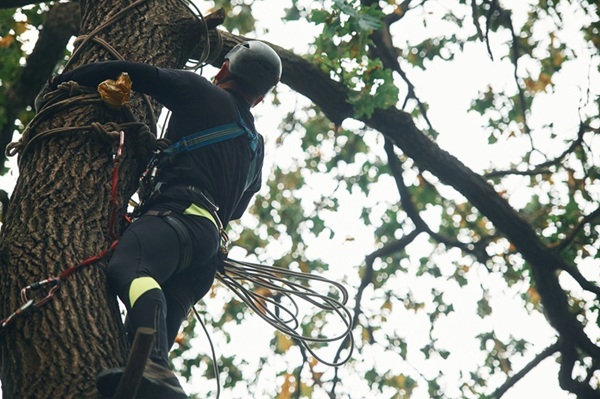
Professional tree removal begins with evaluating the tree and surrounding property. Its size, structural condition, accessibility, and proximity to buildings or utility lines help determine the equipment and removal approach required.
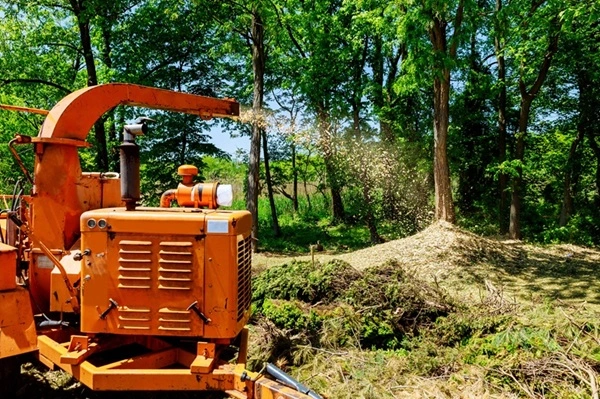
Trees in open areas may allow for more straightforward removal, while those near structures or other obstacles may require controlled sectional removal. Depending on the project, the work may also include processing branches, hauling debris, and grinding the remaining stump.
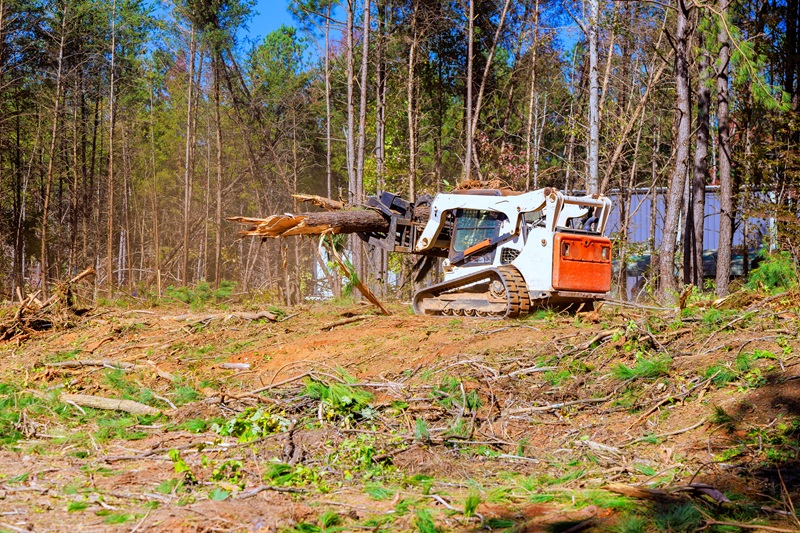
For larger properties, tree removal can be coordinated with land clearing or site preparation when vegetation must be removed before construction or other improvements.
Need Trees Removed for a Land Clearing Project?
Dead branches, trunk decay, root damage, and sudden leaning can indicate problems that deserve professional attention. However, determining whether a tree needs removal depends on its overall condition, structural stability, and proximity to people or property. A qualified arborist can help assess trees that may pose a safety risk.
For property owners preparing land for construction, improving access, or clearing overgrown acreage, tree removal may be one part of a larger project. Corbin Land Management provides land clearing and site preparation services throughout Upstate South Carolina, including removing unwanted trees and vegetation to make properties more usable.
Contact Corbin Land Management to discuss your land clearing project and request an estimate.
Clear the Land. Prepare the Ground. Build With Confidence.
Whether you need to clear an overgrown lot, prepare a building site, improve access, or reshape your property, Corbin Land Management is ready to help.
Contact